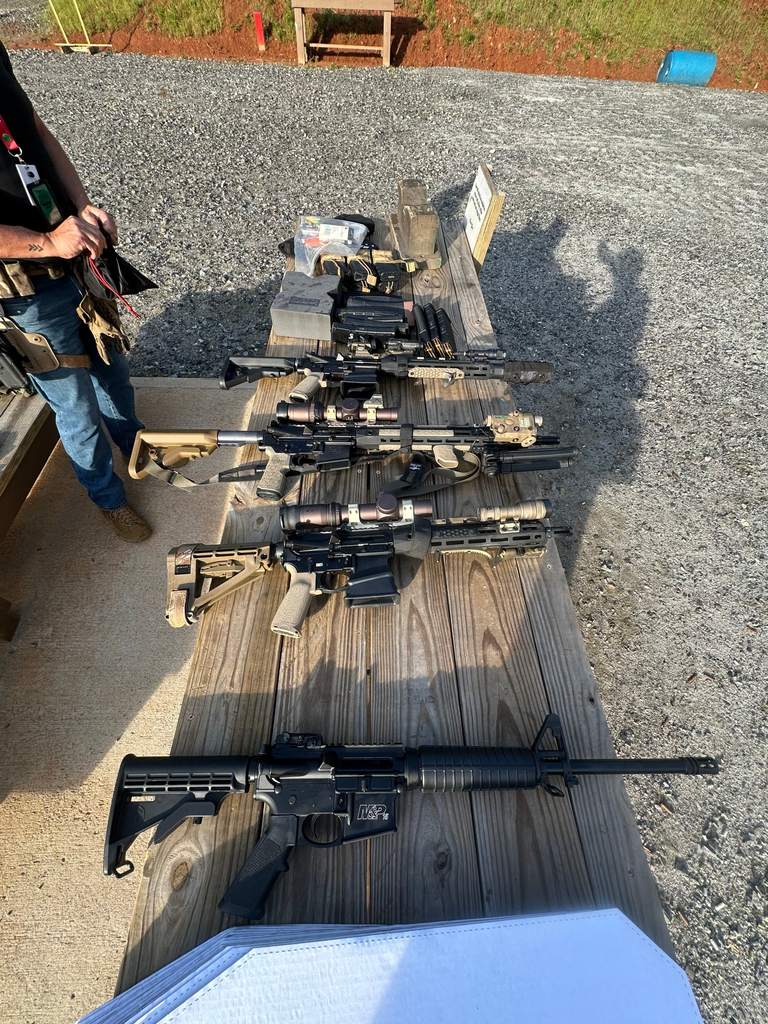
The AR-15 is the most discussed rifle in America and one of the least accurately described. Before anyone can have a sensible conversation about it — buying one, training with one, or arguing about one — it helps to know what the thing actually is.
First, the name
AR is ArmaLite’s own model prefix. Not assault rifle, not automatic rifle — it is the company’s name. ArmaLite was a small firearms division of the Fairchild aircraft company in the 1950s, and it used the AR prefix across its whole catalog. The AR-5 was a bolt-action survival rifle for aircrews. The AR-7 was a .22 that floated. The AR-17 was a shotgun. The number is a model number in a company’s product line, nothing more.
Eugene Stoner was ArmaLite’s chief engineer, and in the mid-1950s he designed the AR-10, a lightweight rifle in the .308-class 7.62×51mm cartridge, built from aluminum and plastics at a time when rifles were steel and walnut. The U.S. military never adopted it, and foreign sales were small. When the Army signalled interest in something smaller, two of Stoner’s colleagues — Robert Fremont and L. James Sullivan — scaled the AR-10 down around a much smaller .22-caliber cartridge, the one we now call .223 Remington, and the result was the AR-15.
ArmaLite was running out of money. In 1959 it sold its rights to the AR-10 and AR-15 to Colt. Colt developed the design into what the U.S. military eventually adopted as the M16, and kept the AR-15 name for its civilian rifles. Colt still owns that name. Rifles from dozens of other makers carry their own model names, but almost everyone calls them AR-15s.
The military rifles Stoner designed were select-fire. The AR-15 sold to civilians is semi-automatic: one round fired per deliberate press of the trigger, exactly like a great many hunting rifles and most modern handguns. That is the key legal difference between the rifle in a gun store and the rifle in a government arsenal, and it is the detail most often lost in conversation.
What “platform” actually means
Here is the part that matters for anyone handling one.
Most rifles are a single object. The AR-15 is two halves joined by two pins, and that architecture is why people call it a platform rather than a rifle.
The lower receiver holds the trigger assembly, the grip, the stock and the magazine well. Legally, in the United States, the lower receiver is the firearm. It carries the serial number. Everything else is, federally, just parts.
The upper receiver holds the barrel, the bolt carrier group, the handguard and the sights or optic. With the rifle unloaded and the magazine out, push out two pins and the two halves separate in a few seconds.
The practical consequence is that one serialized rifle can be set up several different ways over its life. A longer barrel for distance, a different optic for different eyes. (A rifle barrel shorter than 16 inches needs ATF registration first. Ask before you buy one.) For most owners this flexibility is theoretical and they never use it. But it explains the parts industry, the accessory market, and why two rifles that look alike can be very different rifles.
It also explains the ergonomic consistency. Controls sit in the same places, the manual of arms is the same, and on most current models the stock adjusts to the shooter rather than the other way around — which matters a great deal for smaller-framed adults who have spent their lives being handed rifles built for somebody else.
What it is chambered in
The standard chamberings are 5.56×45mm NATO and .223 Remington, which are closely related but not identical. This is one of the few technical details on this subject that carries a real safety consequence, so it is worth stating precisely:
- A rifle chambered in 5.56 NATO can generally fire both 5.56 and .223.
- A rifle chambered strictly in .223 Remington should fire only .223. Two things stack up here: 5.56 is loaded to higher pressure, and the shorter throat in a .223 chamber means the bullet hits the rifling sooner, which raises pressure further.
- Some rifles are marked .223 Wylde, a hybrid chamber built to fire both safely. Rifles marked 5.56 NATO fire both too.
Read what is stamped on your barrel. Then read the headstamp on the cartridge. Make the two agree, every single time, and do not trust the box they came in — boxes get reused and refilled by well-meaning people. If they don’t agree, or you’re not sure, don’t fire it. Ask the rifle’s maker.
Beyond those, the same platform is built in a long list of other cartridges. That variety is real but it is not where a first-time buyer should start.
Why it is popular, honestly
Set the politics aside and the reasons are unglamorous:
Low recoil. The 5.56 cartridge is light. New shooters, smaller adults, and people with shoulder or neck problems can shoot an AR-15 comfortably for an afternoon when a heavier rifle would have them flinching after a dozen rounds. Low recoil means more repetitions, and repetitions are how people actually get better.
Adjustability. On most current models the stock length adjusts in seconds, so one rifle fits several people in a household properly rather than approximately.
Parts and support. Nearly every gunsmith knows the design, most shops stock magazines, and spares are cheap and everywhere.
Accuracy within normal distances. For the ranges most civilians will ever shoot, the platform is usually more accurate than the person holding it, which is the correct relationship.
And the honest caveats
I teach pistol and rifle, and I will tell anyone asking the same things I tell students in person.
It is loud and the blast is sharp. Indoors and without hearing protection it is punishing. That is a genuine consideration in any thinking about home defense, and it is a reason to take the question seriously rather than assume the answer.
Those small bullets travel a long way. Knowing your target and what is beyond it is not an abstraction with a rifle. In a neighborhood, knowing what is beyond your target is a harder problem than it is in a field, and it deserves to be thought about in advance rather than in the moment.
It is a rifle, not a solution. Buying one does not make anybody capable. The platform rewards training and punishes neglect in exactly the same proportion as everything else.
The storage job gets bigger, not smaller. A rifle is harder to secure than a pistol and more interesting to a curious teenager. If a rifle comes into the house, the storage plan has to be settled the same day.
Where to start if you are considering one
Shoot one before you buy one. Rent, or borrow from someone who will supervise you properly. Thirty rounds through a rifle tells you more than thirty hours of reading.
Get the fundamentals first — sight alignment, trigger control, position and breathing. They transfer completely from a .22 to a rifle like this one, and they are far cheaper to learn on a .22.
And have someone show you the manual of arms with the rifle empty, in a classroom, before you take it to a line. Loading, unloading, locking the bolt back, verifying the chamber, clearing a stoppage. That is an hour, it is boring, and it is the hour that makes everything after it safe.
Ward & Steel teaches rifle fundamentals one-to-one and in small groups across North Fulton and Forsyth. 770-744-1893 or [email protected].
This article is an explanation of a firearm design for people deciding whether it suits them. It is not assembly, modification, or gunsmithing guidance, and Ward & Steel does not provide any.