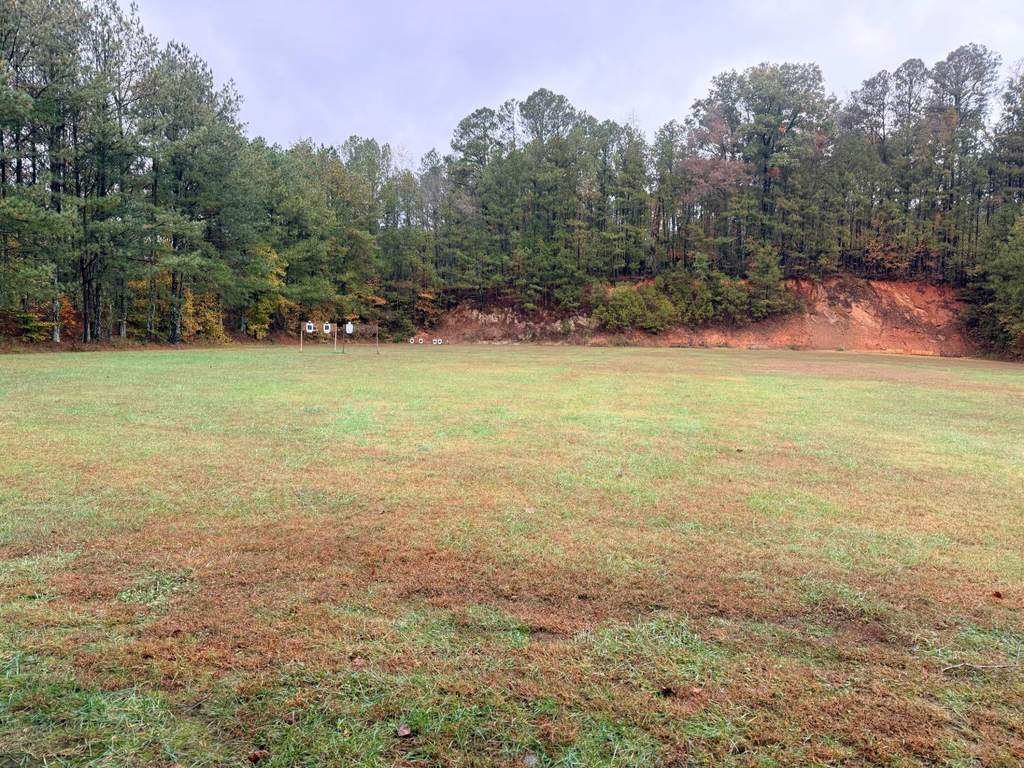
Most people’s picture of a shooting range is an indoor pistol bay: a narrow lane, a target on a motorized carrier, and a wall about twenty-five yards away. An outdoor rifle range is a different place. It is quieter in some ways and louder in others, the distances are longer than you expect, and it runs on a set of shared habits that regulars follow without thinking about them.
If you are heading out for the first time, here is what you will see, how the day works, and what is going on with the paper at the far end.
What 100 yards actually looks like
A football field is 100 yards from goal line to goal line. It is a common distance at outdoor rifle ranges, and it is farther than it sounds. Stand at the bench, hold your thumb out at arm’s length, and it will cover the whole paper target. The bullseye is a dot.
You will usually see target frames set at several distances, often 25, 50 and 100 yards, with a tall earthen berm behind the farthest row. Around Roswell and North Fulton that berm is often Georgia red clay. It is the backstop, and its whole job is to stop every round that leaves the line. Nobody shoots at anything that does not have the berm behind it.
100 yards is also the most common distance for sighting in a rifle, meaning adjusting the sights or scope so the rifle hits where you aim. It is far enough to show small errors and close enough that wind and bullet drop do not swamp what you are trying to learn.
The firing line
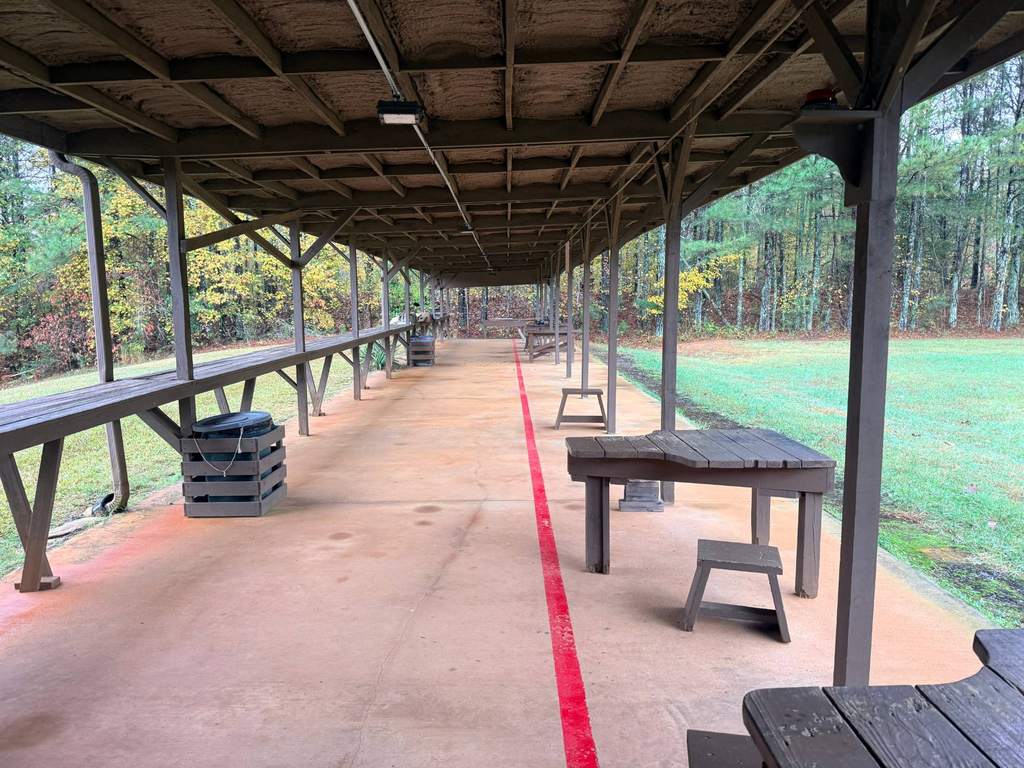
Many outdoor ranges have a covered firing line with a row of shooting benches facing the field. A line on the floor, often a painted stripe, marks the firing line. Shooters stay behind it. Guns stay pointed downrange, toward the berm, at all times.
The range is either hot or cold, and everything else follows from that.
- Hot means shooting is allowed. Once the line is called hot, you can handle your firearm at your bench, load and fire. Nobody is in front of the line.
- Cold means a cease-fire is in effect. Every firearm is unloaded with its action open, set down on the bench pointing downrange, and nobody touches it. Many ranges ask for a chamber flag, a small plastic insert that shows at a glance that the chamber is empty. Shooters step back from the benches. Only then does anyone walk downrange to hang or check targets.
When the last person is back behind the line, the range officer or the shooters agree the line is hot again, and shooting resumes. At most ranges anyone who sees something unsafe can call “cease fire,” and everyone stops immediately. Hearing it and stopping is part of the deal you make by showing up.
Every range posts its own rules, and they differ in the details: how cease-fires are called, whether there is a range officer on duty, whether you can go downrange on your own. Read the posted rules before you unpack anything. These sit on top of the four rules of safe gun handling, never in place of them.
At the bench
A rifle at 100 yards rewards a steady setup. Most people shoot from the bench with the front of the rifle on a bipod or a sandbag and the back of the stock on a small bag, so the rifle is supported at both ends and your body is not holding it up. The goal is for the rifle to sit on target by itself, so that all you are doing is pressing the trigger.
Small things show up on paper at this distance. A breath, a shift in your shoulder, a jerk of the trigger: each one moves the shot. That is the point of the exercise. The target tells you, honestly, what you did.
Bring eye and ear protection and wear them the whole time you are on the line, including when you are not the one shooting. Rifles are loud outdoors, and the person on the next bench is firing whether or not you are. Foam plugs under earmuffs are what hearing-safety experts recommend for shooting. A cap with a brim helps with ejected brass, and in Georgia, water and a layer for the shade under the cover are worth packing most of the year.
Reading the paper
At 100 yards you often cannot see small bullet holes with your eyes alone. Shooters use the rifle’s scope, a spotting scope, or wait for the next cold line and walk down to look.
When you do look, judge the group, not one hole. Fire three or five careful shots, then look at where they landed together. A tight cluster to one side means the rifle and shooter are consistent and the sights need adjusting. A wide scatter often points to the shooter, though ammunition or a loose scope can cause it too. Sort that out before touching the sights.
Scope adjustments are usually measured in one of two units:
- MOA (minute of angle). One MOA is about 1.05 inches at 100 yards. Many scopes move a quarter MOA per click, so four clicks moves the shot about an inch at 100 yards.
- MRAD (milliradian, or “mil”). One mil is 3.6 inches at 100 yards. Mil scopes usually move a tenth of a mil per click, about 0.36 inches at 100 yards.
The turret markings or the scope’s manual give the click value. A grid target, the kind with one-inch squares printed on it, makes the math simple: count the squares from your group to the center. Each square is about four clicks on a quarter-MOA scope, and about three on a tenth-mil scope.
What a first visit with us looks like
A first rifle session with Ward & Steel starts with the safety rules and how the range runs, before any live fire. Then we set up at the bench, work through a steady position and a clean trigger press at a close target, and work out to 100 yards as the basics come together. If you want the structured version, I teach the NRA Basic Rifle Shooting Course. Private sessions are built around what you want to learn and the rifle you have, or the one you are thinking about buying.
You do not need to own a rifle or know anything going in. You need to be willing to go slowly at the start.
If you want to see 100 yards for yourself, it is 770-744-1893 or [email protected].